The Art of Patience: How a Single Calligraphy Piece Takes 40 Hours
By Hassnain Ali
There's a common misunderstanding about calligraphy. People see the final piece — elegant, effortless, flowing — and assume it was written in one sitting. The truth is far more demanding. A single piece of Arabic calligraphy, the kind that hangs in a living room or greets visitors at a mosque entrance, can take over 40 hours from first sketch to final stroke.
It begins with understanding. Before any ink touches paper, we sit with the words. Whether it's a verse from the Quran, a name, or a custom phrase, the meaning shapes the composition. The weight of each word determines where it sits, how large it's written, how much space it breathes.
The Sketching Phase
Every piece starts in pencil. Light, loose, exploratory. We try dozens of compositions — sometimes fifty or more — before one feels right. The balance between letters, the negative space, the rhythm of thick and thin strokes. This phase alone can take eight to ten hours across several days. Rushing it always shows in the final work.
Choosing the Medium
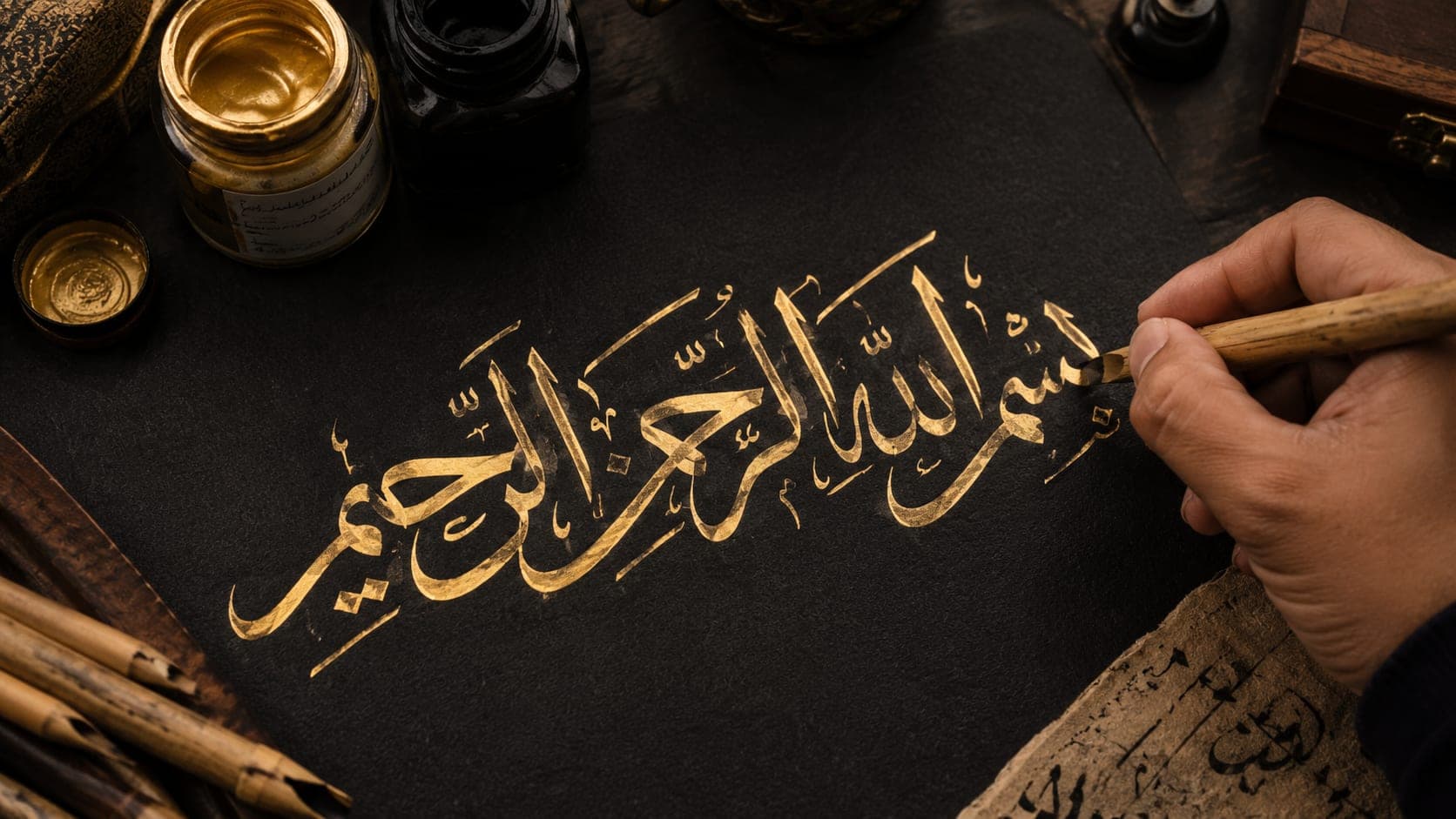
For most commissioned pieces, we work with traditional reed pens cut by hand. Each pen is shaped differently depending on the script style. A Thuluth script demands a wider nib than Naskh. The angle of the cut determines the character of every stroke. We also prepare our own ink in many cases — mixing natural pigments with gum arabic for consistency and permanence.
The Writing
This is where years of training become visible. The actual writing of the final piece might take four to six hours, but it sits on top of fifteen years of daily practice. Every stroke follows precise geometric rules — proportions based on the rhombic dot system that calligraphers have used for over a thousand years.
One mistake and we start over. There is no erasing in traditional calligraphy. No undo button. Each piece you see in our portfolio represents not just the successful version, but the three or four attempts that came before it.
Gilding and Finishing
Many of our pieces feature gold leaf or gold ink detailing. Applying gold leaf is its own discipline — the leaf is thinner than a human hair and tears at the slightest wrong breath. We apply sizing (adhesive) with precision, lay the gold, burnish it smooth, and then add any decorative borders or illumination patterns.
The final piece is sealed, mounted, and framed using conservation-grade materials that protect the work for decades.
Why It Matters
In a world of instant everything, we believe there's profound value in something that took forty hours of focused human attention to create. Every piece carries the energy of that patience. When you hang it in your home or place it in your mosque, you're not just displaying art — you're preserving a tradition that stretches back fourteen centuries.
That's what makes calligraphy different from print. It's not reproduced. It's not generated. It's earned — one stroke at a time.